Okay, I've calmed down a little. Not much, but a little.
Last night's season ender was epic. Not, I think, my favorite all-time Sherlock episode, but certainly an excellent addition to what has been a fairly amazing season.
First things first: I TOLD YOU SO.
While not entirely evil, Mary certainly catapulted into the realm of "complicated" last night. I knew she was way too clever with the code deciphering and the successful playing of both Sherlock and Watson. And, of course, the "liar" and "linguist" warnings from Sherlock's initial reading of her.
I didn't exactly see her shooting Sherlock, though. But my Sherlock-senses were definitely tingling whenever she was on scene.
Things I Loved About Last Night's Episode:
1. Mary - I was worried they were going to straight up villainize her. They didn't. They made her complicated and worthy of a second chance. They also pointed out what everyone already knew: John loves himself a dangerous sociopath. There was no way Mary and he could be happy if she weren't. I'm pretty sure I fist-bumped myself when my earlier deductions were remotely right, though.
2. Moriarty - While it was great to see Moriarty trapped in Sherlock's mind dungeon, it was even greater to see him serve as the perverted deus-ex-machina, saving Sherlock from exile (and, perhaps, most likely death) with his timely return. Of course, there are so many questions here. Is he really back or is this someone using Moriarty's image? How did Moriarty fake his own death? Have the writers decided to go off canon now? It doesn't really matter, of course, since I'm about to pee my pants with excitement about Season 4 regardless.
3. Sherlock fighting death - This entire scene was incredible. My husband said this and I totally agree: they've gotten so much better about showing Sherlock "think" as the seasons go on. Here, it's a mind palace on the brink of collapse. Molly and Mycroft serve as prompters, getting Sherlock to make the necessary calls to save his own life, but it's Moriarty, still tormenting from his padded cell, that really highlights the bond these two sociopaths share, even in death.
4. Molly - Season 3 Molly not only got to kiss Sherlock (albeit in Anderson's fantasy - do with that what you will - although Sherlock did give her a little cheek peck later) but also gets to slap him as well. You go, girl! Molly is braver, feistier, and less likely to suffer fools. When she slaps Sherlock for squandering his gifts, you know it isn't just about that.
5. Sherlock playing human - I'd earlier lamented that they were trying too hard to humanize Sherlock this season, while hoping it was for a greater purpose. Seems it was. While Sherlock clearly has special emotional dispensations for Watson, he is in his element abusing the emotions of Jeanine (last week's bridesmaid) in order to get what he needs/wants. And, of course, we poignantly see him reaffirm his high-functioning sociopathy at the end when he shoots Magnusson in the head. Not a very elegant Holmesian solution, I fear. I hope they won't waste any time on Sherlock feeling guilty about that next season.
6. Christmas - Sherlock's parents are back! This time, for Christmas! And we see just how amazing a Holmes' family Christmas can be. We learn that it's Holmes's mother who is the "genius" (a mathematician turned mommy) - which is probably Moffat's way of saying "See, I'm not a misogynist!' Still, when Sherlock drugs them all to run off to catch Magnusson, you just feel so warm and fuzzy and right.
7. Wiggins - In season one, one of the homeless network girls was named Wiggins. Which was cute and all, but I was hoping Wiggins would be a far more central figure. Prayers answered! The role gets recast here as a junky with a budding interest in deductions and chemistry.
Things I Didn't Love:
1. Magnusson - Sure, he gets shot in the head, but that's so not satisfying. We watch Sherlock because we want to see him mentally best the baddie. Not shoot them in their mind palaces. This felt like a copout or misdirection solely to get to the amazing punchline of the season. And that's a shame, because the guy playing Magnusson was so creepy he could have been a truly special villain. Instead, we just have to take it from Sherlock that he was the most dangerous opponent they've ever come up against. Having Sherlock win by default (if murder can be considered default) feels most unsatisfactory.
Things I Will Obsess Over:
1. AGRA - I'm guessing these initials are the IOU red-herring of Season Three but I can't help to think that Mary's identity and the mysterious USB are a clue I'm somehow missing. Besides, if nothing else, knowing a rogue agent is on your team to fight Moriarty has got to feel good.
2. Did you miss me? I had a feeling this was coming about halfway through the episode. They've used Andrew Scott a lot this year; for a guy who's supposed to be dead, he certainly was getting a fair bit of screen time. If he's really back, that should be an epic season 4. If he's not, it should still be pretty amazing. But I do worry. Now that Sherlock is a "murderer" - what's the incentive at beating Moriarty at his own game? They sacrificed a little of Sherlock's integrity this season and I don't know how or if they'll be able to successfully reclaim it in any meaningful way.
More after the rewatch!
Showing posts with label John Watson. Show all posts
Showing posts with label John Watson. Show all posts
Monday, January 13, 2014

Sunday, January 5, 2014
Sherlock: Sign of Three (Series 3, Episode 2)
Well, well, well, isn't this a horse of a different color? A second or middle episode that was actually pretty amazing.
The Sign of Three was highly anticipated after Sherlock's auspicious return to television. At least highly anticipated in my home. But I was wary. There are some distinct tonal changes going on - Sherlock and Mycroft are far more human, far more accessible, than they were previously. Also, at times, the show teeters on campy. We saw that in the first episode with the Inspector Clouseau bit. Here, it's a bit more subtle, but I can't remember...well...laughing quite so hard at Sherlock in the past.
Maybe I've just obsessively watched the humor out the older series?
Maybe it's Mary. Can I just say how much I fucking love Mary? I'm serious. She's amazing. She plays both Watson and Sherlock so perfectly. And she doesn't dare try to come between them. I hope it lasts because, dang, is she incredible.
I will give some major spoilers of tonight's episode. Here is your final warning. I won't tell you everything - because I've got small children and they're disruptive only in the 90 minute blocks I take for myself at bedtime. Tonight, it was adventures in potty training.
Don't ask.
Anyways, tonight was John's wedding. It did not disappoint. However, first, we saw the return of Donovan, who I'd hoped was away on traffic duty in Canterbury or something but apparently was not. We see her and Lestrade trying to crack down on an elusive gang of clown-faced bank robbers. They're on the brink of capture and police glory when...Sherlock texts! He needs help! Please! Come right away!
Of course, he's texted enough that we all know he is no danger, but Lestrade, well, Lestrade is sticking truer the canon and is not a very good police detective so he calls for all kinds of major backup at Baker St. where a totally fine Sherlock is in the throws of a "best man speech writing" meltdown.
Poor, Gavin. Er...Graham...uh...Greg.
Of course, the thing with the robbers is either all a very elaborate lead up to that punchline or signs of future trouble to come.
The writers are also doing this weird time-hopping thing that is making it difficult to know what time anything is happening in. Flashbacks are problematic that way. And we've definitely jumped forward from Sherlock's amazing return from the dead.
Sherlock gives an amazing speech, if you're worried. He makes the audience laugh and cry and gives us hope of Sherlock's increasing interest in joining society successfully. Peppered throughout are cases the boys have worked on together, including an unsolved case of a bloody guardsman and a ghost boyfriend. There are also some pretty amazing interviews Sherlock conducts with various members of the wedding party. It's nice to see him connect so vividly with a young child.
I'd totally let him babysit.
I was curious to see how they'd handle the central mystery of the Sign of the Four (the locked room). It was actually pretty clever here, although, I dare say, I'd figured it out. I won't tell you how it's done, just pay attention to the filming. They give a little visual hinting with some of the shots.
I also don't believe for a second that Sherlock would have trouble figuring out the intended target. That took way too long, but was fairly hysterical in the process.
Also fun - Sherlock dancing, Sherlock's bridesmaid friend, Sherlock visualizing his chatroom (and those women!!!), and the drinking scene (Sherlock and John both get wasted and try to solve a crime; it is just as epic as you imagine).
Of course, the major spoiler comes with the pun on the title. Changing the Four to Three in the title is surely designed to have people think of the new John-Mary-Sherlock triangle. Of course, we all forget how much the writers love a good pun.
Mary is off-put by wine. She gets nervous and sick in the morning of her wedding. She's put on some weight.
It doesn't really take a Sherlock to deduce what comes next.
But it's really, really sweet when he does.
See you after the rewatch.
The Sign of Three was highly anticipated after Sherlock's auspicious return to television. At least highly anticipated in my home. But I was wary. There are some distinct tonal changes going on - Sherlock and Mycroft are far more human, far more accessible, than they were previously. Also, at times, the show teeters on campy. We saw that in the first episode with the Inspector Clouseau bit. Here, it's a bit more subtle, but I can't remember...well...laughing quite so hard at Sherlock in the past.
Maybe I've just obsessively watched the humor out the older series?
Maybe it's Mary. Can I just say how much I fucking love Mary? I'm serious. She's amazing. She plays both Watson and Sherlock so perfectly. And she doesn't dare try to come between them. I hope it lasts because, dang, is she incredible.
I will give some major spoilers of tonight's episode. Here is your final warning. I won't tell you everything - because I've got small children and they're disruptive only in the 90 minute blocks I take for myself at bedtime. Tonight, it was adventures in potty training.
Don't ask.
Anyways, tonight was John's wedding. It did not disappoint. However, first, we saw the return of Donovan, who I'd hoped was away on traffic duty in Canterbury or something but apparently was not. We see her and Lestrade trying to crack down on an elusive gang of clown-faced bank robbers. They're on the brink of capture and police glory when...Sherlock texts! He needs help! Please! Come right away!
Of course, he's texted enough that we all know he is no danger, but Lestrade, well, Lestrade is sticking truer the canon and is not a very good police detective so he calls for all kinds of major backup at Baker St. where a totally fine Sherlock is in the throws of a "best man speech writing" meltdown.
Poor, Gavin. Er...Graham...uh...Greg.
Of course, the thing with the robbers is either all a very elaborate lead up to that punchline or signs of future trouble to come.
The writers are also doing this weird time-hopping thing that is making it difficult to know what time anything is happening in. Flashbacks are problematic that way. And we've definitely jumped forward from Sherlock's amazing return from the dead.
Sherlock gives an amazing speech, if you're worried. He makes the audience laugh and cry and gives us hope of Sherlock's increasing interest in joining society successfully. Peppered throughout are cases the boys have worked on together, including an unsolved case of a bloody guardsman and a ghost boyfriend. There are also some pretty amazing interviews Sherlock conducts with various members of the wedding party. It's nice to see him connect so vividly with a young child.
I'd totally let him babysit.
I was curious to see how they'd handle the central mystery of the Sign of the Four (the locked room). It was actually pretty clever here, although, I dare say, I'd figured it out. I won't tell you how it's done, just pay attention to the filming. They give a little visual hinting with some of the shots.
I also don't believe for a second that Sherlock would have trouble figuring out the intended target. That took way too long, but was fairly hysterical in the process.
Also fun - Sherlock dancing, Sherlock's bridesmaid friend, Sherlock visualizing his chatroom (and those women!!!), and the drinking scene (Sherlock and John both get wasted and try to solve a crime; it is just as epic as you imagine).
Of course, the major spoiler comes with the pun on the title. Changing the Four to Three in the title is surely designed to have people think of the new John-Mary-Sherlock triangle. Of course, we all forget how much the writers love a good pun.
Mary is off-put by wine. She gets nervous and sick in the morning of her wedding. She's put on some weight.
It doesn't really take a Sherlock to deduce what comes next.
But it's really, really sweet when he does.
See you after the rewatch.
Thursday, January 2, 2014
Sherlock Conspiracy Theory Rears Its Ugly (Fake) Head: More Thoughts and Spoilers from "The Empty Hearse"
Okay, I'm sorry, but you see, I've become Anderson.

And this is how I watch Sherlock now.
Because of all my hard time watching and rewatching earlier episodes, I feel like I have a pretty excellent understanding of the Sherlockian universe. So, with all that said, there a few things still bothering me about yesterday's stunning return.
1. The distinct tonal shift from the previous two seasons. Sherlock has always been a little campy (maniacally so with Andrew Scott's depiction of Moriarty) but it read heavily as drama first. Comic relief certainly occurs, but I'm pretty sure I debated crying for John during The Reichenbach Fall. With Sherlock's gleeful return comes a new surge of manic comedy. While some of it holds true to canon (Mrs. Hudson's histrionics with the frying pan, for example), others do not (Sherlock's nod to Inspector Clouseau). Look, I get that Sherlock meets John again when he is in disguise and that dressing up is something he does frequently. But the scene where he dresses up like a waiter and buffoonishly tromps around the restaurant is off-putting to say the least. And a far departure from the ancient bookseller he appears as in "The Empty House." It felt more like Italian farce and it was distinctly more playful than I recall pre-fall Sherlock being.
2. Mary, Mary, Quite Contrary. Or, perhaps, distinctly not contrary at all. That, too, works with the canon - Mary was no shrew; she never tried to stop John from playing with Sherlock and recognized their work as important. But there is something up with Mary, yes? Let's look at another screencap of Sherlock's reading of her:
 Here are the words of distinct interest to me: clever, shortsighted, guardian, linguist, secret, and liar. Don't get me wrong; I love that she's a size 12 (American size 8) and bakes her own bread, but those aren't really of importance to anything besides her waistline and the projected depiction of her as nurturing and maternal.
A friend of mine argues that Guardian refers to the newspaper, not the role. I think it could be more than that. We already know her politics lean left, so whether or not she reads the Guardian is of little import (and, yes, I know that newspaper reading is a different thing altogether in England than it is here). That leaves two other possibilities: her personality type (myer-briggs) is Guardian or that she operates in some capacity as a guardian herself (as a nurse, that would not be too great of a stretch. also, in intervening on Sherlock's behalf for John's betterment, she, too, seeks to protect and help her fiance). So, that's something to ponder. We also know she is a liar and I've given my thoughts about that as well. The fact that she's clever and a linguist are also particularly of note to me. If she's a nurse, Mary's linguistic skills might pay off with foreign patients. But a secret, clever, lying linguist with a part-time job? That sounds a little bit like my sister might be right and Mary might have been hired by Mycroft to keep tabs on John while Sherlock's away.
Of course, there's another possibility: that Mary will somehow be connected to the big bad. We know precious little about Mary (I suspect we will have a far better picture after Sunday's Sign of Three when we meet whatever she has by way of friends or extended family). I keep thinking about John's abduction. It doesn't make sense. It bothers me. Why does the mystery man in the shadows want John? And, if it's to get to Sherlock specifically, why send the warning to Mary? Let's ponder our Big Bad a little more, shall we?
3. Magnusson. I saw his name go by the bottom of the screen during the Anderson/Goth girl scene (I knew it was too funny and that they had to be trying to sneak something by me!) and googled him. Turns out, he's Milverton, the worst man in England, the blackmailer. And he operates out of the creepiest Island of Misfit Toys I've ever seen.
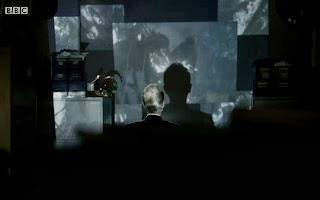 If he is a blackmailer, what exactly is he watching for so intently in the final clip from "The Empty Hearse"? Who is he attempting to extort with that video? Surely not John, he's got to be the pawn. But who is the message for? There's got to be something I'm missing here, but what? Is he connected to Mary (blue-eyed, poor eyesight)? Does this mean we need to consider the Holmes brothers more carefully?
4. I keep thinking back to the tonal shift. In particular, the humanizing moments we see between Sherlock and Mycroft. Like the Goth girl scene, the Operation Game made me feel all warm and fuzzy and loved. Which immediately makes me suspicious. Are they giving us this information/insight now to use it against later? To manipulate us? Mycroft would be an excellent target for a new criminal mastermind, particularly a blackmailer. What am I missing in all this soft talk about Mycroft's isolation and lonely heart?
So, those are my new thoughts. More thoughts. Too many thoughts. Loved all the Guy Fawkes bits. Want to make an effigy that looks like this one for next year:
 Thanks to my sister for all the obsessive screencaps.
More to follow.

And this is how I watch Sherlock now.
Because of all my hard time watching and rewatching earlier episodes, I feel like I have a pretty excellent understanding of the Sherlockian universe. So, with all that said, there a few things still bothering me about yesterday's stunning return.
1. The distinct tonal shift from the previous two seasons. Sherlock has always been a little campy (maniacally so with Andrew Scott's depiction of Moriarty) but it read heavily as drama first. Comic relief certainly occurs, but I'm pretty sure I debated crying for John during The Reichenbach Fall. With Sherlock's gleeful return comes a new surge of manic comedy. While some of it holds true to canon (Mrs. Hudson's histrionics with the frying pan, for example), others do not (Sherlock's nod to Inspector Clouseau). Look, I get that Sherlock meets John again when he is in disguise and that dressing up is something he does frequently. But the scene where he dresses up like a waiter and buffoonishly tromps around the restaurant is off-putting to say the least. And a far departure from the ancient bookseller he appears as in "The Empty House." It felt more like Italian farce and it was distinctly more playful than I recall pre-fall Sherlock being.
2. Mary, Mary, Quite Contrary. Or, perhaps, distinctly not contrary at all. That, too, works with the canon - Mary was no shrew; she never tried to stop John from playing with Sherlock and recognized their work as important. But there is something up with Mary, yes? Let's look at another screencap of Sherlock's reading of her:

A friend of mine argues that Guardian refers to the newspaper, not the role. I think it could be more than that. We already know her politics lean left, so whether or not she reads the Guardian is of little import (and, yes, I know that newspaper reading is a different thing altogether in England than it is here). That leaves two other possibilities: her personality type (myer-briggs) is Guardian or that she operates in some capacity as a guardian herself (as a nurse, that would not be too great of a stretch. also, in intervening on Sherlock's behalf for John's betterment, she, too, seeks to protect and help her fiance). So, that's something to ponder. We also know she is a liar and I've given my thoughts about that as well. The fact that she's clever and a linguist are also particularly of note to me. If she's a nurse, Mary's linguistic skills might pay off with foreign patients. But a secret, clever, lying linguist with a part-time job? That sounds a little bit like my sister might be right and Mary might have been hired by Mycroft to keep tabs on John while Sherlock's away.
Of course, there's another possibility: that Mary will somehow be connected to the big bad. We know precious little about Mary (I suspect we will have a far better picture after Sunday's Sign of Three when we meet whatever she has by way of friends or extended family). I keep thinking about John's abduction. It doesn't make sense. It bothers me. Why does the mystery man in the shadows want John? And, if it's to get to Sherlock specifically, why send the warning to Mary? Let's ponder our Big Bad a little more, shall we?
3. Magnusson. I saw his name go by the bottom of the screen during the Anderson/Goth girl scene (I knew it was too funny and that they had to be trying to sneak something by me!) and googled him. Turns out, he's Milverton, the worst man in England, the blackmailer. And he operates out of the creepiest Island of Misfit Toys I've ever seen.

4. I keep thinking back to the tonal shift. In particular, the humanizing moments we see between Sherlock and Mycroft. Like the Goth girl scene, the Operation Game made me feel all warm and fuzzy and loved. Which immediately makes me suspicious. Are they giving us this information/insight now to use it against later? To manipulate us? Mycroft would be an excellent target for a new criminal mastermind, particularly a blackmailer. What am I missing in all this soft talk about Mycroft's isolation and lonely heart?
So, those are my new thoughts. More thoughts. Too many thoughts. Loved all the Guy Fawkes bits. Want to make an effigy that looks like this one for next year:

More to follow.
Wednesday, January 1, 2014
Sherlock: The Empty Hearse (Season Three, Episode One)
Look, my fellow Americans, I watched this through some sort of voodoo on my computer (it involved convincing my computer that we live in England. Don't ask). If you don't want spoilers, DON'T READ THIS POST.
Glad we got that covered.
I think tonight's episode was a touching nod to the fans.
By which I mean, Moffat and Gatiss clearly trolled the internet to find the most amazing of the crazy theories and just ran with it. I love that Anderson has essentially turned into the Mad Hatter (Hatter being what I will lovingly call a "Sherlock conspiracy theorist"). His introductory scheme was, perhaps, the most entertaining few moments of television I have had all week. It is only surpassed by Scottish Goth Girl's version of what exactly happened on that roof.
Andrew Scott and Benedict Cumberbatch deserve Emmys for that scene. Seriously.
But I digress, if you want to know how it plays out, here you go:
Sherlock is in it with Molly and Mycroft (obviously). His reaction to Moriarty's death is genuine - he should have seen it coming, but did not. He knew he needed to make his death convincing but he also needed to, you know, live. He texts Mycroft letting him know the plan is on, his homeless network and Mycroft's men keep everyone at bay and close off access to the street (like a movie lot), they set up a blue stunt/fall pad, meanwhile the body of the kidnapper is tossed on the ground in order for John to see a Sherlock-esque body lying there. All the equipment gets packed up quickly, Sherlock trades places with the dead body, which gets quickly carted out of sight, he gets surrounded, the squash ball gets put into play, and he is window-dressed to look dead all by the time John gets back on his feet and to him.
Ta da!
Were you all right???
I was close. I knew Mycroft and Molly had to be involved. I guessed my hubs was right about the squash ball (although they never explain what the thing in Sherlock's hand was). I did not see the tarpyfallpad thing but did guess that they put a Sherlock-alike dead body on the ground to switch places with.
Like Anderson, I felt like they're would be more.
Anderson's theory was far more elaborate - masks get used, Moriarty's body gets used, Sherlock and Molly kiss, it's FANTASTIC. But Anderson is like a deranged version of his idiotic former self. He seems to have had some sort of manic break here. I don't know what to do with that.
He heads up a small group of Baker Street Irregulars (not the homeless network, more like a group of believers who are not, to my knowledge, called the Irregulars. But there was a lot of buffering going on).
The Goth Girl's version should be the stuff of every Sherlock fangirl;s dreams.
Want a taste?

The rest of the stuff here is pretty basic mystery solving. Sherlock comes home, rescued by Mycroft (sort of), cleaned up, and returned to the wild of London. John briefly dabbles with an aging mustache (it doesn't last), and we get introduced to Mary, who, I gotta say, I LOVE.
I was really worried about her, because she usually gets played like Yoko Ono and so far there's not a hint of that being the direction here. THANK GOD. I don't want a woman who will break up John and Paul. I want a woman who will sing with the band.
Molly Hooper is also in fine form. Not only does she get to kiss Sherlock this episode (albeit, once in a fantasy sequence), she is also engaged. Before you get too excited and start thinking she's moved on, fear not, she is the same old Molly. Her fiance looks like Matt Smith playing Benedict Cumberbatch playing Sherlock.
It's amazing.
Verdict is out on whether she dresses him for the part or he is THAT into Sherlock. I hope time will tell.
Of course, we also get introduced to this season's big bad. We know he has blue eyes and wears glasses. He also has white hair and a penchant for watching black and white film. Particularly film of Sherlock saving Watson from a fiery death.
Creepy.
Honestly, I was a little disappointed in the big reveal. I think the writers knew that would be the case, though, and that's partly why they gave us such epic variations from the peanut gallery. Of course there will be holes in the plan. And we still don't have a particularly good idea why Sherlock didn't include John (aside from John's need to blog about everything, thus, possibly ruining the big secret), since, you know, everyone else seemed to have an idea.
Although, can I just say, one of my favorite scenes this week was when Lestrade hugs Sherlock. Seriously. I squee-ed a little.
Looking forward to next week already.
Laterz.
Glad we got that covered.
I think tonight's episode was a touching nod to the fans.
By which I mean, Moffat and Gatiss clearly trolled the internet to find the most amazing of the crazy theories and just ran with it. I love that Anderson has essentially turned into the Mad Hatter (Hatter being what I will lovingly call a "Sherlock conspiracy theorist"). His introductory scheme was, perhaps, the most entertaining few moments of television I have had all week. It is only surpassed by Scottish Goth Girl's version of what exactly happened on that roof.
Andrew Scott and Benedict Cumberbatch deserve Emmys for that scene. Seriously.
But I digress, if you want to know how it plays out, here you go:
Sherlock is in it with Molly and Mycroft (obviously). His reaction to Moriarty's death is genuine - he should have seen it coming, but did not. He knew he needed to make his death convincing but he also needed to, you know, live. He texts Mycroft letting him know the plan is on, his homeless network and Mycroft's men keep everyone at bay and close off access to the street (like a movie lot), they set up a blue stunt/fall pad, meanwhile the body of the kidnapper is tossed on the ground in order for John to see a Sherlock-esque body lying there. All the equipment gets packed up quickly, Sherlock trades places with the dead body, which gets quickly carted out of sight, he gets surrounded, the squash ball gets put into play, and he is window-dressed to look dead all by the time John gets back on his feet and to him.
Ta da!
Were you all right???
I was close. I knew Mycroft and Molly had to be involved. I guessed my hubs was right about the squash ball (although they never explain what the thing in Sherlock's hand was). I did not see the tarpyfallpad thing but did guess that they put a Sherlock-alike dead body on the ground to switch places with.
Like Anderson, I felt like they're would be more.
Anderson's theory was far more elaborate - masks get used, Moriarty's body gets used, Sherlock and Molly kiss, it's FANTASTIC. But Anderson is like a deranged version of his idiotic former self. He seems to have had some sort of manic break here. I don't know what to do with that.
He heads up a small group of Baker Street Irregulars (not the homeless network, more like a group of believers who are not, to my knowledge, called the Irregulars. But there was a lot of buffering going on).
The Goth Girl's version should be the stuff of every Sherlock fangirl;s dreams.
Want a taste?
The rest of the stuff here is pretty basic mystery solving. Sherlock comes home, rescued by Mycroft (sort of), cleaned up, and returned to the wild of London. John briefly dabbles with an aging mustache (it doesn't last), and we get introduced to Mary, who, I gotta say, I LOVE.
I was really worried about her, because she usually gets played like Yoko Ono and so far there's not a hint of that being the direction here. THANK GOD. I don't want a woman who will break up John and Paul. I want a woman who will sing with the band.
Molly Hooper is also in fine form. Not only does she get to kiss Sherlock this episode (albeit, once in a fantasy sequence), she is also engaged. Before you get too excited and start thinking she's moved on, fear not, she is the same old Molly. Her fiance looks like Matt Smith playing Benedict Cumberbatch playing Sherlock.
It's amazing.
Verdict is out on whether she dresses him for the part or he is THAT into Sherlock. I hope time will tell.
Of course, we also get introduced to this season's big bad. We know he has blue eyes and wears glasses. He also has white hair and a penchant for watching black and white film. Particularly film of Sherlock saving Watson from a fiery death.
Creepy.
Honestly, I was a little disappointed in the big reveal. I think the writers knew that would be the case, though, and that's partly why they gave us such epic variations from the peanut gallery. Of course there will be holes in the plan. And we still don't have a particularly good idea why Sherlock didn't include John (aside from John's need to blog about everything, thus, possibly ruining the big secret), since, you know, everyone else seemed to have an idea.
Although, can I just say, one of my favorite scenes this week was when Lestrade hugs Sherlock. Seriously. I squee-ed a little.
Looking forward to next week already.
Laterz.
Sherlock Rewatch: The Hounds of Baskerville (Season Two, Episode Two)
What's up with the middle installments being the weakest of each season?

I actually like this one much better than "The Blind Banker", to be fair. I think my problem is that it seems so disconnected from the Moriarty plotline. It makes me think there's got to be something else going on here, aside from hallucinogenic drugs and giant beasties traipsing all over the moors of England.
It does give us this photo:
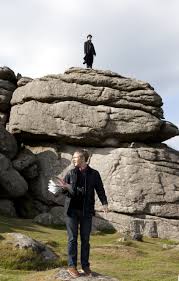
which is foreshadowing at its finest.
This one gives us a flashback by way of intro - clearly a strong connection to the main narrative thread and introducing us to the concept of the Hound through the childhood eyes of terror.
While it's not my favorite episode, here are some things of note:
1. Sherlock's refusal to apologize to Mrs. Hudson. He refuses to, after revealing Mrs. Hudson's unintentional affair with the philandering shopkeeper. She leaves upset and Sherlock refuses to apologize to her, criticizing, or perhaps, envying John's mind for assuming it could be so simple. And yet we see him apologize to Molly, just an episode earlier, for cruelly lashing out about her crush on him. And, the more I think about that scene, the more I'm sure Sherlock knows exactly what he's doing. There's no way a man like Sherlock could not predict or simply read the tag off the gift and know its recipient. He's not jealous of Molly's beau, so what's really going on there?
2. Shaking fingers - "I know the signs". Henry is looking for his first cigarette of the day and Sherlock makes much of his shaking fingers, commenting he recognizes the sign of nicotine withdrawal. Have you ever watched Sherlock's body language? Like really watched it? In Scandal in Belgravia, you can see him shaking his feet/leg repeatedly under his sheet. His finger tick rapidly, particularly when thinking. Very rarely does he stay completely still. In Reichenbach Falls, he sits, feet up, quite relaxed. When else does he ever sit with his feet up? Or completely still? That's certainly not his thinking pose. Does this mean he's drugged at the end? Not in the sense of the hallucinogenic stuff from HOUND; that's got red herring written all over it. Just that there's something else going on with his body language at the end of season finale and we get a clue to it here.
3. I'm a show-off; that's what we do. - I love this line, but I also wonder if it's there for ulterior motives as well. It would be out-of-character for Sherlock not to show-off (i.e. perhaps by asking Molly humbly for help or admitting that he needs her). I'd say look for scenes where Sherlock doesn't show off or can't show off in the finale. Just a thought.
4. Skull and Cross Bones - Another pirate reference (the first one is in Scandal in Belgravia when Mycroft says that his brother has the mind of a philosopher or scientist and yet spends his time acting as a detective. He also comments that initially Sherlock wanted to be a pirate. Do with that what you will.
5. John's blog. I write a blog. Several of them. On average, I get maybe 30 hits a day, more if I write something about Blue Lagoon: The Awakening (that shit is blog GOLD). I have nowhere near the readership of John's blog. Neither does Sherlock. And, yes, John has mysteries and fiction working on his side, but everyone whose anyone in this series seems well-acquainted with John's blog. It's amazing he hasn't monetized it; they could live entirely off that. Here, Dr. Frankland is the avid reader/fan. I feel like John's blog must be getting some outside help in order to be as successful as it seems to be.
6. Much is made of Sherlock's pickpocketing in the first two episodes of this season. First, he nicks the ashtray from the palace and now he's conveniently stolen Mycroft's ID to sneak into Baskerville (which seems unnecessary since Mycroft later gets him 24-hour-access).
7. With your cheekbones and turning up your coat collar to look cool. - I just love this line, but it also speaks to Sherlock's perception of himself and his ego. He knows people are looking at him, watching him, judging him. He wants to project "mysterious" and "cool". It doesn't take a genius to see that.
8. I haven't got friends. I've just got one. - Not true. He has Mrs. Hudson. Lestrade. and John. And Molly. And, in some fucked up way, Moriarty. Definitely not true. But it makes me think of the title change. In the original, it's the Hound of the Baskervilles. Here, it's the HoundS of Baskerville. A nod to the name change more than a moment of truth?
9. Sherlock's "fear" - We get a more emotional side to Sherlock here, with his fear and doubt unsettling him (hand-shaking!). This is either the most human Sherlock has ever been OR this is a set up, a long-con, on Sherlock's part. Making Watson witness his humanity to believe the end he has in store or Reichenbach.
10. Sherlock's mistake - Sherlock assumed the poison was in the sugar, not the in the fog. Making mistakes is distinctly in character for Sherlock, thus his "code" snafu at the end of the season finale isn't particularly out-of-character. Even John says Sherlock is "human" in his blog. I'm not sold entirely on that concept, actually, but it's something to note if you think the out-of-character move is that Sherlock was fallible. Sherlock does say in A Study in Pink that there is always some detail he gets wrong; he's excellent with the big picture, but little things often elude him.
11. Frankland's overly-helpfulness/giving Sherlock his number - it's an old British murder mystery standard that if someone is overly helpful they're probably involved in the murder. Moriarty gives Sherlock his number in The Great Game. Irene practically programs herself into Sherlock's phone. Here, Frankland gives his number. Kitty Riley slips her card to Sherlock in The Reichenbach Fall. Let's just ponder that for a moment, shall we?
12. John's blog entry regarding the episode points out that Sherlock makes Henry look at the body of the dog so that he understands what is real and what is not. I think that is exactly why it is so important that he places John where he does in the Reichenbach fall. John can't see the bloody conclusion, but he must be able to see the body in order to fully believe the lie of Sherlock's death. It's an interesting spin here.
13. Acronyms. HOUND here is a pretty basic acronym of the last name of the drug's founders. This ties into my IOU feeling (that's it something more significant). And the writers love using things from previous episodes to help do that. Liberty, IN also ties into this (IOU could be an abbreviation, of sorts).
See you after the next one.
I actually like this one much better than "The Blind Banker", to be fair. I think my problem is that it seems so disconnected from the Moriarty plotline. It makes me think there's got to be something else going on here, aside from hallucinogenic drugs and giant beasties traipsing all over the moors of England.
It does give us this photo:
which is foreshadowing at its finest.
This one gives us a flashback by way of intro - clearly a strong connection to the main narrative thread and introducing us to the concept of the Hound through the childhood eyes of terror.
While it's not my favorite episode, here are some things of note:
1. Sherlock's refusal to apologize to Mrs. Hudson. He refuses to, after revealing Mrs. Hudson's unintentional affair with the philandering shopkeeper. She leaves upset and Sherlock refuses to apologize to her, criticizing, or perhaps, envying John's mind for assuming it could be so simple. And yet we see him apologize to Molly, just an episode earlier, for cruelly lashing out about her crush on him. And, the more I think about that scene, the more I'm sure Sherlock knows exactly what he's doing. There's no way a man like Sherlock could not predict or simply read the tag off the gift and know its recipient. He's not jealous of Molly's beau, so what's really going on there?
2. Shaking fingers - "I know the signs". Henry is looking for his first cigarette of the day and Sherlock makes much of his shaking fingers, commenting he recognizes the sign of nicotine withdrawal. Have you ever watched Sherlock's body language? Like really watched it? In Scandal in Belgravia, you can see him shaking his feet/leg repeatedly under his sheet. His finger tick rapidly, particularly when thinking. Very rarely does he stay completely still. In Reichenbach Falls, he sits, feet up, quite relaxed. When else does he ever sit with his feet up? Or completely still? That's certainly not his thinking pose. Does this mean he's drugged at the end? Not in the sense of the hallucinogenic stuff from HOUND; that's got red herring written all over it. Just that there's something else going on with his body language at the end of season finale and we get a clue to it here.
3. I'm a show-off; that's what we do. - I love this line, but I also wonder if it's there for ulterior motives as well. It would be out-of-character for Sherlock not to show-off (i.e. perhaps by asking Molly humbly for help or admitting that he needs her). I'd say look for scenes where Sherlock doesn't show off or can't show off in the finale. Just a thought.
4. Skull and Cross Bones - Another pirate reference (the first one is in Scandal in Belgravia when Mycroft says that his brother has the mind of a philosopher or scientist and yet spends his time acting as a detective. He also comments that initially Sherlock wanted to be a pirate. Do with that what you will.
5. John's blog. I write a blog. Several of them. On average, I get maybe 30 hits a day, more if I write something about Blue Lagoon: The Awakening (that shit is blog GOLD). I have nowhere near the readership of John's blog. Neither does Sherlock. And, yes, John has mysteries and fiction working on his side, but everyone whose anyone in this series seems well-acquainted with John's blog. It's amazing he hasn't monetized it; they could live entirely off that. Here, Dr. Frankland is the avid reader/fan. I feel like John's blog must be getting some outside help in order to be as successful as it seems to be.
6. Much is made of Sherlock's pickpocketing in the first two episodes of this season. First, he nicks the ashtray from the palace and now he's conveniently stolen Mycroft's ID to sneak into Baskerville (which seems unnecessary since Mycroft later gets him 24-hour-access).
7. With your cheekbones and turning up your coat collar to look cool. - I just love this line, but it also speaks to Sherlock's perception of himself and his ego. He knows people are looking at him, watching him, judging him. He wants to project "mysterious" and "cool". It doesn't take a genius to see that.
8. I haven't got friends. I've just got one. - Not true. He has Mrs. Hudson. Lestrade. and John. And Molly. And, in some fucked up way, Moriarty. Definitely not true. But it makes me think of the title change. In the original, it's the Hound of the Baskervilles. Here, it's the HoundS of Baskerville. A nod to the name change more than a moment of truth?
9. Sherlock's "fear" - We get a more emotional side to Sherlock here, with his fear and doubt unsettling him (hand-shaking!). This is either the most human Sherlock has ever been OR this is a set up, a long-con, on Sherlock's part. Making Watson witness his humanity to believe the end he has in store or Reichenbach.
10. Sherlock's mistake - Sherlock assumed the poison was in the sugar, not the in the fog. Making mistakes is distinctly in character for Sherlock, thus his "code" snafu at the end of the season finale isn't particularly out-of-character. Even John says Sherlock is "human" in his blog. I'm not sold entirely on that concept, actually, but it's something to note if you think the out-of-character move is that Sherlock was fallible. Sherlock does say in A Study in Pink that there is always some detail he gets wrong; he's excellent with the big picture, but little things often elude him.
11. Frankland's overly-helpfulness/giving Sherlock his number - it's an old British murder mystery standard that if someone is overly helpful they're probably involved in the murder. Moriarty gives Sherlock his number in The Great Game. Irene practically programs herself into Sherlock's phone. Here, Frankland gives his number. Kitty Riley slips her card to Sherlock in The Reichenbach Fall. Let's just ponder that for a moment, shall we?
12. John's blog entry regarding the episode points out that Sherlock makes Henry look at the body of the dog so that he understands what is real and what is not. I think that is exactly why it is so important that he places John where he does in the Reichenbach fall. John can't see the bloody conclusion, but he must be able to see the body in order to fully believe the lie of Sherlock's death. It's an interesting spin here.
13. Acronyms. HOUND here is a pretty basic acronym of the last name of the drug's founders. This ties into my IOU feeling (that's it something more significant). And the writers love using things from previous episodes to help do that. Liberty, IN also ties into this (IOU could be an abbreviation, of sorts).
See you after the next one.
Tuesday, December 31, 2013
Sherlock Rewatch: The Blind Banker (Season One, Episode Two)
"The Blind Banker" which I think we ALL can agree is the weakest installment in the Sherlock canon, opens with a tea ceremony and a date request.

Since I'm currently obsessed with the notion that these opening scenes matter intensely, I'm going with the reiteration of one of Sherlock's central motifs here: You wouldn't like me if you knew the real me. The series loves to play with the idea of disguise as an extension of our inner selves (we see this most poetically in "Scandal in Belgravia" with the priest costume and the naked dominatrix) but the two-sided facet to the human mind is an idea oft-reiterated as well (in next episode's Janus Cars, for example).
The creators of Sherlock love the idea that a criminal mastermind could be walking around, just like everybody else, unassuming in disposition until it's too late.
Really, only a few things of significance or note happened in this episode (for me, personally, although I'm sure for others, this episode was their favorite):
1. The Code - we get introduced to the smuggler's code here (the Chinese numbers that correspond to page numbers in the tourist's guidebook). The episode ends with Sherlock commenting that the next code is probably already in play and John watching a Chinese street tagger using white paint to write a new cypher on a mailbox (I think it's a mailbox). If something is going to get taken from this episode and manipulated later, my money is that it's the code.
2. John gets mistaken for Sherlock - I think this one is crucial, actually. John very easily gets mistaken for Sherlock - he has Sherlock's tickets and a check for Sherlock in his wallet. He also was overhead saying "I'm the great Sherlock Holmes!" sarcastically (but we all know how well that translates). It's just that easy. It also makes Moriarty's statement that he is Sherlock/Sherlock is him feel that much more significant. In this world, it is really that simple to become somebody else.
3. The German Tourists - THERE IS SOMETHING GOING ON HERE WITH GERMANY. I DON'T KNOW WHAT. BUT THERE IS SOMETHING.
4. We all get to meet Benedict Cumberbatch's ex-girlfriend and rejoice in her beautiful normalcy, thus giving legions of single women everywhere the hope that they too can snag a sexy otter-faced actor of their own someday. Yay, Cheekbones!
5. Sherlock flirts with Molly. Many people seem to think Sherlock asking Molly for help is "out of character" for him. It's really not, if you watch the early episodes. He even manipulates her best by taking advantage of her known feelings for him. He might employ different tactics later, but Sherlock isn't immune to knowing when someone has feelings for him and exploiting those feelings when it benefits him.
6. Whoever is in charge of the newspapers here deserves a handshake. "Who Wants to be a Million-Hair". HA! But, seriously, the effort put into the newspapers is crucial. Later, they'll sneak by an article about the renovations at St. Bart's. Clue for Reichenbach? Probably.
7. Cinematographic juxtaposition. We get a glimpse of the beauty of "Scandal"'s juxtaposition in the scene of John and Sherlock at the beginning of this episode. While John fights with "a machine", Sherlock squares off with masked assailant. It's quick and campy but hints at greatness to come. These writers love a good foil.
8. Longshot Theory: Chinese acrobatics help Sherlock "fall"
See you next episode.
Since I'm currently obsessed with the notion that these opening scenes matter intensely, I'm going with the reiteration of one of Sherlock's central motifs here: You wouldn't like me if you knew the real me. The series loves to play with the idea of disguise as an extension of our inner selves (we see this most poetically in "Scandal in Belgravia" with the priest costume and the naked dominatrix) but the two-sided facet to the human mind is an idea oft-reiterated as well (in next episode's Janus Cars, for example).
The creators of Sherlock love the idea that a criminal mastermind could be walking around, just like everybody else, unassuming in disposition until it's too late.
Really, only a few things of significance or note happened in this episode (for me, personally, although I'm sure for others, this episode was their favorite):
1. The Code - we get introduced to the smuggler's code here (the Chinese numbers that correspond to page numbers in the tourist's guidebook). The episode ends with Sherlock commenting that the next code is probably already in play and John watching a Chinese street tagger using white paint to write a new cypher on a mailbox (I think it's a mailbox). If something is going to get taken from this episode and manipulated later, my money is that it's the code.
2. John gets mistaken for Sherlock - I think this one is crucial, actually. John very easily gets mistaken for Sherlock - he has Sherlock's tickets and a check for Sherlock in his wallet. He also was overhead saying "I'm the great Sherlock Holmes!" sarcastically (but we all know how well that translates). It's just that easy. It also makes Moriarty's statement that he is Sherlock/Sherlock is him feel that much more significant. In this world, it is really that simple to become somebody else.
3. The German Tourists - THERE IS SOMETHING GOING ON HERE WITH GERMANY. I DON'T KNOW WHAT. BUT THERE IS SOMETHING.
4. We all get to meet Benedict Cumberbatch's ex-girlfriend and rejoice in her beautiful normalcy, thus giving legions of single women everywhere the hope that they too can snag a sexy otter-faced actor of their own someday. Yay, Cheekbones!
5. Sherlock flirts with Molly. Many people seem to think Sherlock asking Molly for help is "out of character" for him. It's really not, if you watch the early episodes. He even manipulates her best by taking advantage of her known feelings for him. He might employ different tactics later, but Sherlock isn't immune to knowing when someone has feelings for him and exploiting those feelings when it benefits him.
6. Whoever is in charge of the newspapers here deserves a handshake. "Who Wants to be a Million-Hair". HA! But, seriously, the effort put into the newspapers is crucial. Later, they'll sneak by an article about the renovations at St. Bart's. Clue for Reichenbach? Probably.
7. Cinematographic juxtaposition. We get a glimpse of the beauty of "Scandal"'s juxtaposition in the scene of John and Sherlock at the beginning of this episode. While John fights with "a machine", Sherlock squares off with masked assailant. It's quick and campy but hints at greatness to come. These writers love a good foil.
8. Longshot Theory: Chinese acrobatics help Sherlock "fall"
See you next episode.
Subscribe to:
Posts (Atom)