This is my first book of 2014, a year in which I hope to read more than every Fancy Nancy or Stephanie Plum out there.
I mean, I'll still read those other books, but I kinda hope I read some stuff that resembles "real" literature, too.
First, a caveat: I feel the need to be spiritually pure for as long as possible this year, and, sadly, that means being honest in my reviews. Not that I usually lie, because I don't, but that sometimes I will say mean things. I will try not to be mean for mean's sake (unless I feel like the book deserves it) and I will make no personal attacks against the writer.
Unless some garbled up piece of fanfic gets mainstream popularity again.
Did I already break my book resolution?
I say this because I'm not really sure how I feel about this book at all. And, considering I've read it and thought about it for a while now, isn't probably a good thing.
You need to understand: I get satire. I teach AP Lit to brilliant 12th graders. Or, I used to in a semi-former life (I'm on sabbatical). I'm not so rusty that it eludes me. This doesn't feel particularly like satire, unless Maria Semple is a mean girl who hates the Hollywood machine and Seattle housewives everywhere.
And I don't think she does. Or I hope she doesn't. Because feminism! Or something.
So, if she's not trying to make fun of reclusive geniuses everywhere or their aesthetically-minded, neurotic neighbors...I guess I'm not entirely certain what's the point.
There is a distinct black comedy vibe here; and, with comedy, an author runs the risk that what you think is funny does not mesh with what another person deems hilarious. It's actually even worse in literature because everything has to be amped up to eleven (one does not simply fall into a lake in books; one trips on one's overly long pants thus causing them to spontaneously rip up the side revealing one's undergarments as one spins wildly out of control culminating in a ceremonious drenching in a local waterhole that happens to be populated by nuns and schoolchildren). If the reader is not on the same wavelength, comedy, sometimes, reads as "What the fuck?!" and that's not good for anyone.
I didn't know much about this book before I borrowed it from the library. I knew that it had an almost four star rating and that my aunt was sort of iffy on it while my cousin recommended it violently. Those were all pretty good indications I'd like this one well enough. The premise seemed a bit...dramatic...to me "reclusive architect disappears and brilliant teenaged daughter tries to find her".
Let's just say, nothing particularly screamed "COMEDY!" to me. And so imagine my surprise when that was what I was faced with.
This, obviously, worked against the novel for me. It was until about 100 pages in when I turned to my unsuspecting husband and said, "Huh. I think this is supposed to be funny." Which was better than thirty pages before when I told him I just didn't get the point.
There's a lot going on in this one that is beyond the absurd: genius parents, art vs. science. social anxiety, stilted creativity, boarding school, Antarctica, lawsuits, interventions, TEDtalks, affairs, the Russian mafia, a house-destroying mudslide, unplanned pregnancies, drug rehabilitation wilderness camp, and an uncle named Van.
This is a world where people act erratically and cash seems limitless. It's also a world where forgiveness and disappearance walk hand in hand, apparently.
I get the overwhelming greater message about creativity and being who you are and acceptance and love. I do. And, once I stopped trying so hard, it was much more fun to get lost in the crazy escapades of Bernadette and her kin. But no one here was particularly likable. First, Bernadette, who is our shining star, is batshit crazy. And, yeah, I know that genius and insanity are often a subtle dance held barely in check by creative outlet and the right combination of medication, but that's not what is happening here. I sympathized with her abhorrence for social interaction and nothing there seemed wildly out of sync with my preferred reality (which is probably saying something very telling about me). Obviously I'm way higher functioning than Bernadette ever was but it was not the off-putting part to me. Her reliance on the internet drone was weird, particularly that, for a genius, she was so quick to give away highly sensitive information like social security and bank account numbers.
There is no way the Russian mob would have waited that long to take all of her cash.
And I get why she leaves. The end sort of worked for me on that level. But she's not ever really approachable in scope. She feels, way too often, like the victim. A self-centered, highly neurotic, quirky, artistic victim that her husband indulges, her neighbor hates, and her daughter reveres.
And Bee was one of those precocious book children that reads as impossible. And then her dad called her a little bitch and I got indignant until she agreed he was right.
Plus, what the hell was up with the Josh Groban thing?
I'm sure we were meant to laugh at Bee, while she weeps and tries to turn herself into the reincarnation of Jesus while listening to Christmas carols and sporting a bandanna advertising The Hangover, but I just couldn't do it.
I'm not into that level of absurdity.
And this is before I get into Elgin, Soo-Lin, and Audrey.
Nobody seemed happy here. And maybe nobody really is. Was that the point? We are all weird locally-sourced architectural designs and when we fail it is because we designed ourselves to do so? Because damn that's bleak. But that's sort of what the first 2/3 of the book felt like to me. Like I was that damn house on the hill, just waiting for the bulldozers to come.
Then we went to Antartica and the tone shifted and we were light as blue ice and restored with hope and reunion.
And that just confused me more.
"Bernadette" is an interesting, if not at times upsetting, read. There are genuinely funny moments here, but, too often, absurd and cruel ones.
3.5 stars - an inauspicious start to a new year.
Friday, January 3, 2014

An Open Letter to Chris Kluwe
Dear Mr. Kluwe,
I'm having a sort of rough morning. My children are playing with Lalaloopsy dolls - do you have the unfortunate pleasure of knowing those? They're these Neil Gaiman-inspired plastic demons with pink hair and black button eyes. Someday, I will find one in my bed and that will be the end of me. But that is, I suppose, neither here nor there. The dolls have the stomach flu. This essentially means my children rip off the dolls overly ruffled, Japanime-inspired clothes and force me to redress them. Over and over. Ad infinitum. Ad nauseum. I was tired of listening to the repetitive chatter of the game. Sure, the first time you hear, "Mommy! Cookie Crumble has poop on her dress!" the adrenalin is enough to sustain you. By the thirteenth time, the game has lost its patina.
That is how I came to read your article this morning. A diversionary expedition into the world of Facebook, a quick glimpse at George Takei's page, and suddenly I wished for the sweet banter of compulsive doll vomiting.
I wanted to say thank you. And, I promise, I won't be too long-winded in doing so. I recently had a bouncy baby boy of my own (he will never be an NFL player at all, most likely) and when he was three months old I sat him down for an important talk. I told him that it was okay with me if he had a girlfriend when he got bigger. Or a boyfriend. He could be as asexual as Sherlock Holmes or a Kinsey six and he would always be welcome and loved in my home. And, to be fair, I've had this talk with all my children at some point in their infancy. My husband and I want our children to know - from very early on, apparently - that we accept them and we love them. I would honestly have a harder time raising a staunch conservative than I would a gay child (obviously, from a personal perspective. Society would be far more accepting of the former, despite the recent rise in popularity of Glee and Modern Family). We all have our prejudicial crosses to bear.
When you first started writing about gay marriage rights, I began to have hope, for the first time in a long time, that equality in this capacity was possible in my lifetime. Your values, your prowess with a well-placed expletive, your calling out of those so vocally vile on the subject - these things warmed my heart. These are values that are important in our family; we believe that marriage rights are not exclusive to the straight population. We also believe you need to stand up for what you believe is morally right. Especially when it isn't easy for you to do so. We don't always practice what we preach, but we do try. And we work exceptionally hard not to make anyone feel like a second-class citizen. Even if they like country music or Chris Christie.
We're also from the liberal northeast. There are many more like us up here than there are in other places. Perk of geography, I suppose.
I thought what you were doing was brave. I also suspected you probably didn't see it that way. But, at the time, I was an unmarried mother of two, living my own small version of a non-traditional lifestyle and afraid of public retribution should my bastard babies become common knowledge. A professional football player being outspoken about the subject of equality was a courageous novelty, indeed.
The last few weeks I've been a little down. Several of my "friends" on Facebook have been highly supportive of Phil Robertson's "freedom of speech." "Listen to what he's saying - he isn't judging! He just doesn't believe gay marriage is right! Everyone is entitled, nay, FREE to have their own opinion!" they'd clamor. Then they'd quote Sarah Palin or Ted Cruz or someone else I find politically and morally vile and they'd sit smugly back, confident that Phil should be revered because it gives him the heebie-jeebies to imagine two men having intercourse.
They ignored the fact that Phil Robertson also made a pretty (pardon the horrific pun) off-color remark about "slaves" "smiling" before they were emancipated. And certainly none of those people are championing his right to marry a girl under the age of sixteen to avoid statutory rape charges. Or, if they are, they're not posting crappy memes about it on Twitterland.
I hope they are truly happy that they've hitched their stars to his batshit crazy wagon.
This was the Chik-Fil-A debacle all over again. Only, instead of people clamoring that the right to eat truly delicious fried chicken was on par with the rights of two same-sex people to marry, we have a dynastic duck patriarch as the misplaced idol.
So, when I read your post this morning, the first thing I thought was: I wonder how many people will support Chris Kluwe. I expect, as I'm sure you do, many people will hold fast to the belief that you were fired for your performance, despite what the numbers say and despite what you remark about sacrificing your numbers for the betterment of the team. They'll cling to this version of facts because it's easier that way for them to keep their steadfast belief that two men or two women in love are somehow less than they are.
They won't see you as a Phil Robertson, because they disagree with your politics. They'll use some ad hominem attack or reverse the logic that you getting fired for your political activism is, somehow, the same as Phil Robertson getting a paid vacation for his. The words "discrimination" and "faulty syllogism" mean nothing to these people; it isn't worth trying to explain it to them.
But, again, I digress.
The long and short of it is: in activism, often times, whether intentionally or not, people get thrust into the limelight as faces of the cause. This has been your lot, I'm afraid. While, perhaps, it came at the cost of your NFL career, it has opened doors for you that otherwise would have been closed. I suspect you'll write, you'll tweet, you'll game, and you'll support gay rights.
That sounds like a pretty good life to me, too.
Thursday, January 2, 2014
Sherlock Conspiracy Theory Rears Its Ugly (Fake) Head: More Thoughts and Spoilers from "The Empty Hearse"
Okay, I'm sorry, but you see, I've become Anderson.

And this is how I watch Sherlock now.
Because of all my hard time watching and rewatching earlier episodes, I feel like I have a pretty excellent understanding of the Sherlockian universe. So, with all that said, there a few things still bothering me about yesterday's stunning return.
1. The distinct tonal shift from the previous two seasons. Sherlock has always been a little campy (maniacally so with Andrew Scott's depiction of Moriarty) but it read heavily as drama first. Comic relief certainly occurs, but I'm pretty sure I debated crying for John during The Reichenbach Fall. With Sherlock's gleeful return comes a new surge of manic comedy. While some of it holds true to canon (Mrs. Hudson's histrionics with the frying pan, for example), others do not (Sherlock's nod to Inspector Clouseau). Look, I get that Sherlock meets John again when he is in disguise and that dressing up is something he does frequently. But the scene where he dresses up like a waiter and buffoonishly tromps around the restaurant is off-putting to say the least. And a far departure from the ancient bookseller he appears as in "The Empty House." It felt more like Italian farce and it was distinctly more playful than I recall pre-fall Sherlock being.
2. Mary, Mary, Quite Contrary. Or, perhaps, distinctly not contrary at all. That, too, works with the canon - Mary was no shrew; she never tried to stop John from playing with Sherlock and recognized their work as important. But there is something up with Mary, yes? Let's look at another screencap of Sherlock's reading of her:
 Here are the words of distinct interest to me: clever, shortsighted, guardian, linguist, secret, and liar. Don't get me wrong; I love that she's a size 12 (American size 8) and bakes her own bread, but those aren't really of importance to anything besides her waistline and the projected depiction of her as nurturing and maternal.
A friend of mine argues that Guardian refers to the newspaper, not the role. I think it could be more than that. We already know her politics lean left, so whether or not she reads the Guardian is of little import (and, yes, I know that newspaper reading is a different thing altogether in England than it is here). That leaves two other possibilities: her personality type (myer-briggs) is Guardian or that she operates in some capacity as a guardian herself (as a nurse, that would not be too great of a stretch. also, in intervening on Sherlock's behalf for John's betterment, she, too, seeks to protect and help her fiance). So, that's something to ponder. We also know she is a liar and I've given my thoughts about that as well. The fact that she's clever and a linguist are also particularly of note to me. If she's a nurse, Mary's linguistic skills might pay off with foreign patients. But a secret, clever, lying linguist with a part-time job? That sounds a little bit like my sister might be right and Mary might have been hired by Mycroft to keep tabs on John while Sherlock's away.
Of course, there's another possibility: that Mary will somehow be connected to the big bad. We know precious little about Mary (I suspect we will have a far better picture after Sunday's Sign of Three when we meet whatever she has by way of friends or extended family). I keep thinking about John's abduction. It doesn't make sense. It bothers me. Why does the mystery man in the shadows want John? And, if it's to get to Sherlock specifically, why send the warning to Mary? Let's ponder our Big Bad a little more, shall we?
3. Magnusson. I saw his name go by the bottom of the screen during the Anderson/Goth girl scene (I knew it was too funny and that they had to be trying to sneak something by me!) and googled him. Turns out, he's Milverton, the worst man in England, the blackmailer. And he operates out of the creepiest Island of Misfit Toys I've ever seen.
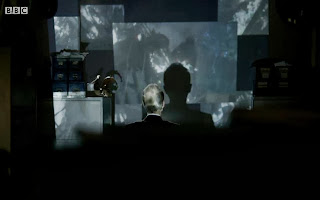 If he is a blackmailer, what exactly is he watching for so intently in the final clip from "The Empty Hearse"? Who is he attempting to extort with that video? Surely not John, he's got to be the pawn. But who is the message for? There's got to be something I'm missing here, but what? Is he connected to Mary (blue-eyed, poor eyesight)? Does this mean we need to consider the Holmes brothers more carefully?
4. I keep thinking back to the tonal shift. In particular, the humanizing moments we see between Sherlock and Mycroft. Like the Goth girl scene, the Operation Game made me feel all warm and fuzzy and loved. Which immediately makes me suspicious. Are they giving us this information/insight now to use it against later? To manipulate us? Mycroft would be an excellent target for a new criminal mastermind, particularly a blackmailer. What am I missing in all this soft talk about Mycroft's isolation and lonely heart?
So, those are my new thoughts. More thoughts. Too many thoughts. Loved all the Guy Fawkes bits. Want to make an effigy that looks like this one for next year:
 Thanks to my sister for all the obsessive screencaps.
More to follow.

And this is how I watch Sherlock now.
Because of all my hard time watching and rewatching earlier episodes, I feel like I have a pretty excellent understanding of the Sherlockian universe. So, with all that said, there a few things still bothering me about yesterday's stunning return.
1. The distinct tonal shift from the previous two seasons. Sherlock has always been a little campy (maniacally so with Andrew Scott's depiction of Moriarty) but it read heavily as drama first. Comic relief certainly occurs, but I'm pretty sure I debated crying for John during The Reichenbach Fall. With Sherlock's gleeful return comes a new surge of manic comedy. While some of it holds true to canon (Mrs. Hudson's histrionics with the frying pan, for example), others do not (Sherlock's nod to Inspector Clouseau). Look, I get that Sherlock meets John again when he is in disguise and that dressing up is something he does frequently. But the scene where he dresses up like a waiter and buffoonishly tromps around the restaurant is off-putting to say the least. And a far departure from the ancient bookseller he appears as in "The Empty House." It felt more like Italian farce and it was distinctly more playful than I recall pre-fall Sherlock being.
2. Mary, Mary, Quite Contrary. Or, perhaps, distinctly not contrary at all. That, too, works with the canon - Mary was no shrew; she never tried to stop John from playing with Sherlock and recognized their work as important. But there is something up with Mary, yes? Let's look at another screencap of Sherlock's reading of her:

A friend of mine argues that Guardian refers to the newspaper, not the role. I think it could be more than that. We already know her politics lean left, so whether or not she reads the Guardian is of little import (and, yes, I know that newspaper reading is a different thing altogether in England than it is here). That leaves two other possibilities: her personality type (myer-briggs) is Guardian or that she operates in some capacity as a guardian herself (as a nurse, that would not be too great of a stretch. also, in intervening on Sherlock's behalf for John's betterment, she, too, seeks to protect and help her fiance). So, that's something to ponder. We also know she is a liar and I've given my thoughts about that as well. The fact that she's clever and a linguist are also particularly of note to me. If she's a nurse, Mary's linguistic skills might pay off with foreign patients. But a secret, clever, lying linguist with a part-time job? That sounds a little bit like my sister might be right and Mary might have been hired by Mycroft to keep tabs on John while Sherlock's away.
Of course, there's another possibility: that Mary will somehow be connected to the big bad. We know precious little about Mary (I suspect we will have a far better picture after Sunday's Sign of Three when we meet whatever she has by way of friends or extended family). I keep thinking about John's abduction. It doesn't make sense. It bothers me. Why does the mystery man in the shadows want John? And, if it's to get to Sherlock specifically, why send the warning to Mary? Let's ponder our Big Bad a little more, shall we?
3. Magnusson. I saw his name go by the bottom of the screen during the Anderson/Goth girl scene (I knew it was too funny and that they had to be trying to sneak something by me!) and googled him. Turns out, he's Milverton, the worst man in England, the blackmailer. And he operates out of the creepiest Island of Misfit Toys I've ever seen.

4. I keep thinking back to the tonal shift. In particular, the humanizing moments we see between Sherlock and Mycroft. Like the Goth girl scene, the Operation Game made me feel all warm and fuzzy and loved. Which immediately makes me suspicious. Are they giving us this information/insight now to use it against later? To manipulate us? Mycroft would be an excellent target for a new criminal mastermind, particularly a blackmailer. What am I missing in all this soft talk about Mycroft's isolation and lonely heart?
So, those are my new thoughts. More thoughts. Too many thoughts. Loved all the Guy Fawkes bits. Want to make an effigy that looks like this one for next year:

More to follow.
Sherlock: The Empty Hearse (Season 3, Episode 1) - More Thoughts and Spoilers
So, first, a correction. Turns out, like Sherlock, I'm fallible.
Anderson's group is called "The Empty Hearse." This is embarrassing and I'm sure I did catch it the first time around but I assumed the real empty hearse of the story was, of course, a pun on Sherlock's empty grave (or sort of empty grave) and the empty car holding all those explosives under Parliament.
My bad.
To make amends:

Don't say I never gave you anything.
In all fairness, for the real fans, it's the few seconds immediately preceding the kiss which are the most epic - when Sherlock runs his hands through his hair. You're going to want to check out the GIF on the BBC One Tumblr. Christmas came late this year.
So, back to the story. There were a couple of moments I've been thinking about since I wrote my initial reaction.
First, the Holmes bros. It seems the Cold War is thawing between the two boys - so much so that they even engage in a battle of the wits (they play Operation. it is just as awesome as you're now imagining). We even get to see a little deductive reasoning on Mycroft's part, which also allows Sherlock the opportunity to pay him back for the "how would you know" line in "Scandal in Belgravia."
Turns out, our little Mycroft is lonely. Awwww.
Don't go and give him a soul now, Gatiss and Moffat. We like our Holmes boys just a little bit more detached than the average human.
We also get to meet Sherlock and Mycroft's parents - played, quite rightly, by Benedict Cumberbatch's real parents. It was sweet to see the whole family together - a bizarre little Christmas card for true fans - and I think it was sporting of the creators to try guess what Sherlock's parents would actually be like. They're so...normal! And sweet! Except, you know, like Benedict Cumberbatch, they sort of reek of old money, even if there isn't any. When Mycroft has to go with them to see "Les Miz," we all would have paid money to see a scene of that.
But you knew that their parents would have to be loving, if nothing else. Look how coddled Sherlock is! He is, essentially, a petulant child with the brain of a genius and the cheekbones of a gangly, foppish Armani model. For tweaked hyper-geniuses, the Holmes boys certainly are well-adjusted.
After all, they didn't turn into Moriarty.
Too soon?
And, of course, I think we need to consider the possibility that Sherlock lies to Anderson about Project Lazarus. He did say there were 13 possibilities once he reached the rooftop of St. Bart's. If he was really going to use Mycroft the entire time, wasn't there really only one possibility once he was on the roof? Come on, now. Of course, with his ego, he was probably banking on being able to talk Moriarty out of killing him entirely.
And, after giggling with child-like glee, kissing. BECAUSE THAT'S WHAT PEOPLE DO.
in fan-fiction.
But the thing I really want to talk about is the Lestrade hug.
Just kidding, but damn do I hope the slashers are going fucking nuts with that today.
No, this is what I want to talk about:
 This took forever to find a screencap of but it's important to me because I knew that we would have to contend with the Mary factor.
Was she too good to be true? Let's look at some of Sherlock's deductions about her: cat lover, bakes own bread, part-time nurse, only child, disillusioned, size 12, lib//dem, secret, tattoo, guardian, shortsighted, and, of course, liar.
In fact, liar shows up a lot (not in this particular pic but in others I've seen). Now, to some degree, we are all liars (I lie all the time, about wanting to read Fancy Nancy books or about wanting to watch Caillou) so we shouldn't all immediately jump on the "Mary is evil" bandwagon. But since she's a liar AND she has a secret, I think we need to maybe brace ourselves for the possibility that...
...maybe Mary is evil.
Blue eyes and shortsighted? Could she somehow be connected to the blue-eyed, glasses-wearing big bad we caught our first glimpse of last night? Or is she lying about wanting to help reconcile John and Sherlock? What are her motives here? Is she as good as she seems or will she break up the band?
I hope not. I hope that she is merely human and loving, if not slightly damaged by the vulnerabilities of life, as are we all.
But, let's face it, this is Moffat and Gatiss we're talking about here.
Bitch is probably evil.
Anderson's group is called "The Empty Hearse." This is embarrassing and I'm sure I did catch it the first time around but I assumed the real empty hearse of the story was, of course, a pun on Sherlock's empty grave (or sort of empty grave) and the empty car holding all those explosives under Parliament.
My bad.
To make amends:

Don't say I never gave you anything.
In all fairness, for the real fans, it's the few seconds immediately preceding the kiss which are the most epic - when Sherlock runs his hands through his hair. You're going to want to check out the GIF on the BBC One Tumblr. Christmas came late this year.
So, back to the story. There were a couple of moments I've been thinking about since I wrote my initial reaction.
First, the Holmes bros. It seems the Cold War is thawing between the two boys - so much so that they even engage in a battle of the wits (they play Operation. it is just as awesome as you're now imagining). We even get to see a little deductive reasoning on Mycroft's part, which also allows Sherlock the opportunity to pay him back for the "how would you know" line in "Scandal in Belgravia."
Turns out, our little Mycroft is lonely. Awwww.
Don't go and give him a soul now, Gatiss and Moffat. We like our Holmes boys just a little bit more detached than the average human.
We also get to meet Sherlock and Mycroft's parents - played, quite rightly, by Benedict Cumberbatch's real parents. It was sweet to see the whole family together - a bizarre little Christmas card for true fans - and I think it was sporting of the creators to try guess what Sherlock's parents would actually be like. They're so...normal! And sweet! Except, you know, like Benedict Cumberbatch, they sort of reek of old money, even if there isn't any. When Mycroft has to go with them to see "Les Miz," we all would have paid money to see a scene of that.
But you knew that their parents would have to be loving, if nothing else. Look how coddled Sherlock is! He is, essentially, a petulant child with the brain of a genius and the cheekbones of a gangly, foppish Armani model. For tweaked hyper-geniuses, the Holmes boys certainly are well-adjusted.
After all, they didn't turn into Moriarty.
Too soon?
And, of course, I think we need to consider the possibility that Sherlock lies to Anderson about Project Lazarus. He did say there were 13 possibilities once he reached the rooftop of St. Bart's. If he was really going to use Mycroft the entire time, wasn't there really only one possibility once he was on the roof? Come on, now. Of course, with his ego, he was probably banking on being able to talk Moriarty out of killing him entirely.
And, after giggling with child-like glee, kissing. BECAUSE THAT'S WHAT PEOPLE DO.
in fan-fiction.
But the thing I really want to talk about is the Lestrade hug.
Just kidding, but damn do I hope the slashers are going fucking nuts with that today.
No, this is what I want to talk about:

Was she too good to be true? Let's look at some of Sherlock's deductions about her: cat lover, bakes own bread, part-time nurse, only child, disillusioned, size 12, lib//dem, secret, tattoo, guardian, shortsighted, and, of course, liar.
In fact, liar shows up a lot (not in this particular pic but in others I've seen). Now, to some degree, we are all liars (I lie all the time, about wanting to read Fancy Nancy books or about wanting to watch Caillou) so we shouldn't all immediately jump on the "Mary is evil" bandwagon. But since she's a liar AND she has a secret, I think we need to maybe brace ourselves for the possibility that...
...maybe Mary is evil.
Blue eyes and shortsighted? Could she somehow be connected to the blue-eyed, glasses-wearing big bad we caught our first glimpse of last night? Or is she lying about wanting to help reconcile John and Sherlock? What are her motives here? Is she as good as she seems or will she break up the band?
I hope not. I hope that she is merely human and loving, if not slightly damaged by the vulnerabilities of life, as are we all.
But, let's face it, this is Moffat and Gatiss we're talking about here.
Bitch is probably evil.
Wednesday, January 1, 2014
Sherlock: The Empty Hearse (Season Three, Episode One)
Look, my fellow Americans, I watched this through some sort of voodoo on my computer (it involved convincing my computer that we live in England. Don't ask). If you don't want spoilers, DON'T READ THIS POST.
Glad we got that covered.
I think tonight's episode was a touching nod to the fans.
By which I mean, Moffat and Gatiss clearly trolled the internet to find the most amazing of the crazy theories and just ran with it. I love that Anderson has essentially turned into the Mad Hatter (Hatter being what I will lovingly call a "Sherlock conspiracy theorist"). His introductory scheme was, perhaps, the most entertaining few moments of television I have had all week. It is only surpassed by Scottish Goth Girl's version of what exactly happened on that roof.
Andrew Scott and Benedict Cumberbatch deserve Emmys for that scene. Seriously.
But I digress, if you want to know how it plays out, here you go:
Sherlock is in it with Molly and Mycroft (obviously). His reaction to Moriarty's death is genuine - he should have seen it coming, but did not. He knew he needed to make his death convincing but he also needed to, you know, live. He texts Mycroft letting him know the plan is on, his homeless network and Mycroft's men keep everyone at bay and close off access to the street (like a movie lot), they set up a blue stunt/fall pad, meanwhile the body of the kidnapper is tossed on the ground in order for John to see a Sherlock-esque body lying there. All the equipment gets packed up quickly, Sherlock trades places with the dead body, which gets quickly carted out of sight, he gets surrounded, the squash ball gets put into play, and he is window-dressed to look dead all by the time John gets back on his feet and to him.
Ta da!
Were you all right???
I was close. I knew Mycroft and Molly had to be involved. I guessed my hubs was right about the squash ball (although they never explain what the thing in Sherlock's hand was). I did not see the tarpyfallpad thing but did guess that they put a Sherlock-alike dead body on the ground to switch places with.
Like Anderson, I felt like they're would be more.
Anderson's theory was far more elaborate - masks get used, Moriarty's body gets used, Sherlock and Molly kiss, it's FANTASTIC. But Anderson is like a deranged version of his idiotic former self. He seems to have had some sort of manic break here. I don't know what to do with that.
He heads up a small group of Baker Street Irregulars (not the homeless network, more like a group of believers who are not, to my knowledge, called the Irregulars. But there was a lot of buffering going on).
The Goth Girl's version should be the stuff of every Sherlock fangirl;s dreams.
Want a taste?

The rest of the stuff here is pretty basic mystery solving. Sherlock comes home, rescued by Mycroft (sort of), cleaned up, and returned to the wild of London. John briefly dabbles with an aging mustache (it doesn't last), and we get introduced to Mary, who, I gotta say, I LOVE.
I was really worried about her, because she usually gets played like Yoko Ono and so far there's not a hint of that being the direction here. THANK GOD. I don't want a woman who will break up John and Paul. I want a woman who will sing with the band.
Molly Hooper is also in fine form. Not only does she get to kiss Sherlock this episode (albeit, once in a fantasy sequence), she is also engaged. Before you get too excited and start thinking she's moved on, fear not, she is the same old Molly. Her fiance looks like Matt Smith playing Benedict Cumberbatch playing Sherlock.
It's amazing.
Verdict is out on whether she dresses him for the part or he is THAT into Sherlock. I hope time will tell.
Of course, we also get introduced to this season's big bad. We know he has blue eyes and wears glasses. He also has white hair and a penchant for watching black and white film. Particularly film of Sherlock saving Watson from a fiery death.
Creepy.
Honestly, I was a little disappointed in the big reveal. I think the writers knew that would be the case, though, and that's partly why they gave us such epic variations from the peanut gallery. Of course there will be holes in the plan. And we still don't have a particularly good idea why Sherlock didn't include John (aside from John's need to blog about everything, thus, possibly ruining the big secret), since, you know, everyone else seemed to have an idea.
Although, can I just say, one of my favorite scenes this week was when Lestrade hugs Sherlock. Seriously. I squee-ed a little.
Looking forward to next week already.
Laterz.
Glad we got that covered.
I think tonight's episode was a touching nod to the fans.
By which I mean, Moffat and Gatiss clearly trolled the internet to find the most amazing of the crazy theories and just ran with it. I love that Anderson has essentially turned into the Mad Hatter (Hatter being what I will lovingly call a "Sherlock conspiracy theorist"). His introductory scheme was, perhaps, the most entertaining few moments of television I have had all week. It is only surpassed by Scottish Goth Girl's version of what exactly happened on that roof.
Andrew Scott and Benedict Cumberbatch deserve Emmys for that scene. Seriously.
But I digress, if you want to know how it plays out, here you go:
Sherlock is in it with Molly and Mycroft (obviously). His reaction to Moriarty's death is genuine - he should have seen it coming, but did not. He knew he needed to make his death convincing but he also needed to, you know, live. He texts Mycroft letting him know the plan is on, his homeless network and Mycroft's men keep everyone at bay and close off access to the street (like a movie lot), they set up a blue stunt/fall pad, meanwhile the body of the kidnapper is tossed on the ground in order for John to see a Sherlock-esque body lying there. All the equipment gets packed up quickly, Sherlock trades places with the dead body, which gets quickly carted out of sight, he gets surrounded, the squash ball gets put into play, and he is window-dressed to look dead all by the time John gets back on his feet and to him.
Ta da!
Were you all right???
I was close. I knew Mycroft and Molly had to be involved. I guessed my hubs was right about the squash ball (although they never explain what the thing in Sherlock's hand was). I did not see the tarpyfallpad thing but did guess that they put a Sherlock-alike dead body on the ground to switch places with.
Like Anderson, I felt like they're would be more.
Anderson's theory was far more elaborate - masks get used, Moriarty's body gets used, Sherlock and Molly kiss, it's FANTASTIC. But Anderson is like a deranged version of his idiotic former self. He seems to have had some sort of manic break here. I don't know what to do with that.
He heads up a small group of Baker Street Irregulars (not the homeless network, more like a group of believers who are not, to my knowledge, called the Irregulars. But there was a lot of buffering going on).
The Goth Girl's version should be the stuff of every Sherlock fangirl;s dreams.
Want a taste?
The rest of the stuff here is pretty basic mystery solving. Sherlock comes home, rescued by Mycroft (sort of), cleaned up, and returned to the wild of London. John briefly dabbles with an aging mustache (it doesn't last), and we get introduced to Mary, who, I gotta say, I LOVE.
I was really worried about her, because she usually gets played like Yoko Ono and so far there's not a hint of that being the direction here. THANK GOD. I don't want a woman who will break up John and Paul. I want a woman who will sing with the band.
Molly Hooper is also in fine form. Not only does she get to kiss Sherlock this episode (albeit, once in a fantasy sequence), she is also engaged. Before you get too excited and start thinking she's moved on, fear not, she is the same old Molly. Her fiance looks like Matt Smith playing Benedict Cumberbatch playing Sherlock.
It's amazing.
Verdict is out on whether she dresses him for the part or he is THAT into Sherlock. I hope time will tell.
Of course, we also get introduced to this season's big bad. We know he has blue eyes and wears glasses. He also has white hair and a penchant for watching black and white film. Particularly film of Sherlock saving Watson from a fiery death.
Creepy.
Honestly, I was a little disappointed in the big reveal. I think the writers knew that would be the case, though, and that's partly why they gave us such epic variations from the peanut gallery. Of course there will be holes in the plan. And we still don't have a particularly good idea why Sherlock didn't include John (aside from John's need to blog about everything, thus, possibly ruining the big secret), since, you know, everyone else seemed to have an idea.
Although, can I just say, one of my favorite scenes this week was when Lestrade hugs Sherlock. Seriously. I squee-ed a little.
Looking forward to next week already.
Laterz.
Sherlock Rewatch - Reichenbach Fall (Series Two Finale) - Part Two
Did you miss me???
Of course not. Only my sister is reading these.
It's just a magic trick. I think we all can agree on that.
Sherlock positions John exactly where he wants him - there's a building and a lorry in his way. The cyclist also deliberately knocks John down and discombobulates him. No drugs needed - just a little shock and a minor head injury.
Sherlock preps John for what we will see: "keep your eyes fixed on me" (which, of course, John doesn't because Sherlock designs it so he can't. But that's the point. John will feel as if he had). He needs John to serve as some kind of witness, but not the one John has prepped in his mind.
Sherlock also throws down his phone. I found this particularly interesting considering his sentimentality surrounding phones (he keeps Irene Adler's and the pink phone from The Great Game is among the possessions of Sherlock's Lestrade returns to Watson in the minisode). Sherlock doesn't want to risk the phone getting squished. Why? Whatever message he left on it has to be preserved for someone. He can't take any chances and tosses it aside.
The ball theory loses a bit of traction for me when Sherlock spreads his arm and flies off the roof. The way that works is if he sandwiches the ball in his armpit to cut off circulation. Certainly, flapping your arms around would a. dislodge the ball and b. get that circulation pumping. If Sherlock wants the ball for after he lands, perhaps he moves it somewhere advantageous for when he's on the ground. But that, too, seems overly complicated. Rubber balls bounce. They can fall out of pockets. There's definitely something in his hand on the rooftop, something that will help him with his plan, but the likelihood of it being a ball is slim when you think that out. Sherlock likes plans that are elegant. Everything hinging on a rubber ball isn't anything but.
I keep looking at this picture.
Sherlock seems to be wearing a white undershirt of some kind (we know he's got a purple shirt on) and there's also a string or a band or something in his coat. I'm guessing these things are part of the actual shoot (the harness and the cord) and not part of the solution, but there you go anyways. We also know from Dan Brown that one square yard of fabric can slow a fall down 20%. How many yards do you wager Sherlock's coat is?
There won't be any jetpacks and I doubt Sherlock managed to convince someone else to jump for him. It would not shock me if the body is already waiting on the ground once Sherlock jumps, but it's tough to deny that's the real Benedict Cumberbatch dead-eyeing us as Sherlock when John checks his pulse.
I think what we basically have to acknowledge is that Sherlock jumps. He is able to slow his fall down and his homeless network takes care of the rest (there's a girl crying who looks vaguely like Wiggins as John approaches). There's a bald man who also looks pretty familiar - a face you'd lose in the crowd if you weren't paying attention.
There are also some huge loose ends. Why is the jury forewoman also in the first press conference from A Study in Pink? Why do her children look very similar to cabbie Jeff Hope's kids? How will they bring back Sherlock, considering he probably still is wanted for resisting arrest? And where has Sherlock been hiding? Besides Germany.
Fucking Germany.
What did all the fairy tale references mean? And IOU? anything? Nothing?
Personally, I'm looking forward to seeing the answers. I know Mycroft was in on the joke already (he figured out Rich Brook way in advance of Sherlock's telling us the joke's punchline on the roof). With Mycroft and Molly, anything is possible for Sherlock.
Catch U later.
Of course not. Only my sister is reading these.
It's just a magic trick. I think we all can agree on that.
Sherlock positions John exactly where he wants him - there's a building and a lorry in his way. The cyclist also deliberately knocks John down and discombobulates him. No drugs needed - just a little shock and a minor head injury.
Sherlock preps John for what we will see: "keep your eyes fixed on me" (which, of course, John doesn't because Sherlock designs it so he can't. But that's the point. John will feel as if he had). He needs John to serve as some kind of witness, but not the one John has prepped in his mind.
Sherlock also throws down his phone. I found this particularly interesting considering his sentimentality surrounding phones (he keeps Irene Adler's and the pink phone from The Great Game is among the possessions of Sherlock's Lestrade returns to Watson in the minisode). Sherlock doesn't want to risk the phone getting squished. Why? Whatever message he left on it has to be preserved for someone. He can't take any chances and tosses it aside.
The ball theory loses a bit of traction for me when Sherlock spreads his arm and flies off the roof. The way that works is if he sandwiches the ball in his armpit to cut off circulation. Certainly, flapping your arms around would a. dislodge the ball and b. get that circulation pumping. If Sherlock wants the ball for after he lands, perhaps he moves it somewhere advantageous for when he's on the ground. But that, too, seems overly complicated. Rubber balls bounce. They can fall out of pockets. There's definitely something in his hand on the rooftop, something that will help him with his plan, but the likelihood of it being a ball is slim when you think that out. Sherlock likes plans that are elegant. Everything hinging on a rubber ball isn't anything but.
I keep looking at this picture.

Sherlock seems to be wearing a white undershirt of some kind (we know he's got a purple shirt on) and there's also a string or a band or something in his coat. I'm guessing these things are part of the actual shoot (the harness and the cord) and not part of the solution, but there you go anyways. We also know from Dan Brown that one square yard of fabric can slow a fall down 20%. How many yards do you wager Sherlock's coat is?
There won't be any jetpacks and I doubt Sherlock managed to convince someone else to jump for him. It would not shock me if the body is already waiting on the ground once Sherlock jumps, but it's tough to deny that's the real Benedict Cumberbatch dead-eyeing us as Sherlock when John checks his pulse.
I think what we basically have to acknowledge is that Sherlock jumps. He is able to slow his fall down and his homeless network takes care of the rest (there's a girl crying who looks vaguely like Wiggins as John approaches). There's a bald man who also looks pretty familiar - a face you'd lose in the crowd if you weren't paying attention.
There are also some huge loose ends. Why is the jury forewoman also in the first press conference from A Study in Pink? Why do her children look very similar to cabbie Jeff Hope's kids? How will they bring back Sherlock, considering he probably still is wanted for resisting arrest? And where has Sherlock been hiding? Besides Germany.
Fucking Germany.
What did all the fairy tale references mean? And IOU? anything? Nothing?
Personally, I'm looking forward to seeing the answers. I know Mycroft was in on the joke already (he figured out Rich Brook way in advance of Sherlock's telling us the joke's punchline on the roof). With Mycroft and Molly, anything is possible for Sherlock.
Catch U later.
Sherlock Rewatch: The Reichenbach Fall (Series 2 Finale) - Part One
And, here we are, at last.
The final problem. Our problem.
How does Sherlock do it?
One of my all-time favorite scenes in the series is when Jim breaks into the Tower of London, followed directly by the scene where Moriarty and Sherlock have tea. Hands down, top two scenes in the series for me.
I'm pretty sure I could act this episode out in my sleep.

The big theme here is fairy tales, but I'm pretty sure that's all smoke and mirrors. Moriarty explains to Sherlock that every fairy tales needs a good, old-fashioned villain. And, naturally, he's the best man for the job. He also explains to Sherlock that they're the same; he is Sherlock and vice versa. That means, at any given point, he can be the hero and Sherlock can be the villain. That is, essentially, exactly what happens here. The breadcrumbs, the gingerbread man, the book of Grimm tales, etc. - these all reinforce Jim's "storyteller" motif. He is playing the puppet master here, and the strings he is pulling are Sherlock's.
Or so he thinks.
If there's anything we know about Sherlock, it's that he's steps ahead of everyone (Except maybe Mycroft, and a little fuzzier when he's bored). But he's been expecting Moriarty for some time now. He expects him in A Study in Pink, even before he has a name. How much puppet mastery Moriarty is doing versus how much Sherlock has put in place in order for him to pull strings is debatable.
Particularly considering Sherlock's condemnation of Moriarty as a "spider at the center of a web". If Moriarty has a web, so, too, does Sherlock. And I'd argue that Sherlock is pulling them a lot sooner than Moriarty gives him credit for.
Moriarty's final problem centers around Bach. When he enters Sherlock's apartment (and is greeted by a fresh-made pot of tea, served to him, uncharacteristically by Sherlock who never serves anyone), he criticizes Sherlock's abrupt cessation of violin playing and begins a tale of a dying, old Bach, leaping out of his bed to play his unfinished melody on the piano. This is a made up story, from what I can gather. The writers spin this legend here for a reason, as Moriarty's "key code" is also from Bach. Add to the fact that he assumes the anglicized version of the name Reichen Bach, and I do believe we've got here a pattern of three that's hard to ignore.
After Moriarty tells the Bach story, Sherlock asks him how Moriarty intends to "burn him" - to which Moriarty replies, that's the final problem. "I've already told you, but did you listen?" We all listened to his "Stayin' Alive" ringtone at the beginning of the "Scandal in Belgravia" and he reiterates that one the roof that "staying alive" is "the final problem." But there's got to be more there, particularly since it's sandwiched between the two Bach incidents. And once more I'm struggling to figure out what a dying man's need to finish the melody has to do with Sherlock jumping off a building.
If Moriarty assumes the Bach role (and we assume that because he literally does take Bach's name), he is the dying man (and die he does, on the rooftop). Sherlock is co-opting his melody, playing him poorly, and stopping before it's finished (Sherlock does this earlier when he stops playing the violin before the song is done). So, what exactly is Moriarty's song? It's staying alive.
But, if that were the case, a dying Jim would leap up and finish the song for Sherlock once he'd stopped playing, right?
I've thought about this so long my head hurts.
We also know Sherlock has a far better understanding of what's going to happen then he lets on. He knows Moriarty's strength isn't in technology but in manipulation. Moriarty's weakness is that he loves playing with people's pressure points; Sherlock anticipates this. He knows that Moriarty will target anyone Sherlock seems to care about on more than a perfunctory level. This is why he treats Molly the way that he does. He has to give her enough to stay involved in his life but must mistreat her in order for Jim to not see her as anything more significant than a schoolgirl crush. He checks this theory on the roof when he gives Moriarty three names - John, Hudson, Lestrade - to ensure that Molly will go unnoticed, as she has too often by everyone else on the series. Her ability to hang in the periphery is exceptional and those are strings that Sherlock manipulates, not Moriarty.
None of that is particularly new, however.
Let's see if we can't decipher the missing clue as a break, shall we?
There are several strange Sherlock moments here.
1. His interaction with Kitty - this actually reminds me a lot of the scene with Irene Adler, he even gets very close to Kitty as if to check to see her pulse or pupil dilation or whathaveyou. Never before is Sherlock so condemnatory of the press. This is probably a deliberate move on Sherlock's part to help turn the press against him; what better way to get them to hate him then to pick a young, hungry journalist and practically hand her a reason to find his dirty secrets.
2. Sherlock makes tea and gets dressed for Moriarty. I think this is incredibly telling. Sherlock wouldn't even get dressed for the Queen, even though he knew exactly where he was going that day. The Queen (via Mycroft and Harry) also served him tea. What message then does Sherlock send Moriarty when he not only gets fully dressed but also serves him tea for his visit? The fact that he practically serenades him with violin music is just an added bonus.
3. Sherlock's apology to John on the roof - Sherlock made a big deal of not apologizing to Mrs. Hudson after hurting her feelings in "Hounds of Baskerville." It's not really in his nature, although he does do it on occasion (see: Molly at Christmas). The question then becomes "What is this apology really all about?".
4. Sherlock sitting with his feet up - Sherlock moves a lot. Even when it appears he isn't moving. And his thinking pose either involves his violin or holding his hands in a pyramid pose. He generally also moves his fingers (as he does when he plays with the squash ball, mirroring Moriarty's code tick). But the scene when John receives the call about Mrs. Hudson, Sherlock is sitting almost perfectly still with his feet up. Why is he elevating his feet here? There's something about his pose and the calmness of his demeanor that is very "not" Sherlock there.
5. Sherlock singing - I've watched all six episodes so much that I can quote them by heart now. I cannot remember one other instance of Sherlock singing. I also think it's strange that he jumps up and clicks his feet together, but that's more typical of his spry and giddy glee when he's excited. Like an acrobatic little puppy.
6. Leaving a "note" - The writers love a pun. I say that all the time and I think it's universally acknowledged to be true. In his final call to John, he tells him, using Moriarty's words, "that's what people do", that he is leaving John "a note." A note can refer to anything - a suicide note, a doctor's note, a music note, a bank note, or even an intonation. In that regards, Sherlock certainly is leaving a note of sadness, of apology, and of despair. Still, I feel like there is more to this phone call than people generally acknowledge. First, it's weird that it's an apology. It's also weird that it's a lie - that he's telling John to continue Moriarty's lie about him, even though John already knows it's untrue (because he lived it and because he spoke with Mycroft). There has to be something more going on there.
7. Sherlock's humanity - crying on the roof is misdirection. Think back to Ian Monkford and Sherlock's quick tears there. Don't mistake this for an out-of-character act. Sherlock is selling his lie here. Hard. He also has grown to like having John around. It isn't easy to do what he's doing but that doesn't mean that he's going soft. Remember, Sherlock is Jim and both men are actors. They can cry, if that's what the scene requires.
8. Sherlock's hands. Much is made of his hands in the rooftop scene, and for some good reason. At the beginning of the exchange, Sherlock has his hands clasped behind his back, the gesture is slightly open, as if to say, "nothing in here to see!". When he gives Moriarty back the code, he has the hands on top closed tight, again, as if to prove there is nothing inside his hands. After he deliberately angers Moriarty by pretending a key code exists, Moriarty calls him a doofus and flamboyantly shuffles around pretending to be ordinary Sherlock. Before this happens, however, we get a brief glimpse at Sherlock's hands again. We know that Sherlock is adept at sleight of hand (thanks, stolen ashtray and id card). When we see him again, his hands look like this. There is clearly something in there, probably the squash ball, because, let's face it, he has never played with one of those prior to this episode. The object looks blackish and squishy (technical terms) but the image isn't very clear; I suppose it could be a recorder or a phone, but he really wouldn't need one of those to be hanging out here. By playing stupid, Sherlock essentially cons Moriarty into letting his guard down. Moriarty takes his eyes off him and Sherlock places the object wherever he needs to do so in order or the next phase of his plan to take place. Whatever the object is, we know for certain it's out of his hands by the time Moriarty's done calling him names.
9. Sherlock's phone - it's weird enough that he calls. It's weird to me that they don't show him taking the phone out and calling John, focusing rather on his feet. We know where he put his phone prior to the encounter on the roof and maybe they're just going for drama, or maybe they're obscuring something we might not want to see until later.
I just checked the time. Right now, someone in England is getting the answer and I'm not. Sadness.
I'm posting this now but will be back in a few with more
The final problem. Our problem.
How does Sherlock do it?
One of my all-time favorite scenes in the series is when Jim breaks into the Tower of London, followed directly by the scene where Moriarty and Sherlock have tea. Hands down, top two scenes in the series for me.
I'm pretty sure I could act this episode out in my sleep.
The big theme here is fairy tales, but I'm pretty sure that's all smoke and mirrors. Moriarty explains to Sherlock that every fairy tales needs a good, old-fashioned villain. And, naturally, he's the best man for the job. He also explains to Sherlock that they're the same; he is Sherlock and vice versa. That means, at any given point, he can be the hero and Sherlock can be the villain. That is, essentially, exactly what happens here. The breadcrumbs, the gingerbread man, the book of Grimm tales, etc. - these all reinforce Jim's "storyteller" motif. He is playing the puppet master here, and the strings he is pulling are Sherlock's.
Or so he thinks.
If there's anything we know about Sherlock, it's that he's steps ahead of everyone (Except maybe Mycroft, and a little fuzzier when he's bored). But he's been expecting Moriarty for some time now. He expects him in A Study in Pink, even before he has a name. How much puppet mastery Moriarty is doing versus how much Sherlock has put in place in order for him to pull strings is debatable.
Particularly considering Sherlock's condemnation of Moriarty as a "spider at the center of a web". If Moriarty has a web, so, too, does Sherlock. And I'd argue that Sherlock is pulling them a lot sooner than Moriarty gives him credit for.
Moriarty's final problem centers around Bach. When he enters Sherlock's apartment (and is greeted by a fresh-made pot of tea, served to him, uncharacteristically by Sherlock who never serves anyone), he criticizes Sherlock's abrupt cessation of violin playing and begins a tale of a dying, old Bach, leaping out of his bed to play his unfinished melody on the piano. This is a made up story, from what I can gather. The writers spin this legend here for a reason, as Moriarty's "key code" is also from Bach. Add to the fact that he assumes the anglicized version of the name Reichen Bach, and I do believe we've got here a pattern of three that's hard to ignore.
After Moriarty tells the Bach story, Sherlock asks him how Moriarty intends to "burn him" - to which Moriarty replies, that's the final problem. "I've already told you, but did you listen?" We all listened to his "Stayin' Alive" ringtone at the beginning of the "Scandal in Belgravia" and he reiterates that one the roof that "staying alive" is "the final problem." But there's got to be more there, particularly since it's sandwiched between the two Bach incidents. And once more I'm struggling to figure out what a dying man's need to finish the melody has to do with Sherlock jumping off a building.
If Moriarty assumes the Bach role (and we assume that because he literally does take Bach's name), he is the dying man (and die he does, on the rooftop). Sherlock is co-opting his melody, playing him poorly, and stopping before it's finished (Sherlock does this earlier when he stops playing the violin before the song is done). So, what exactly is Moriarty's song? It's staying alive.
But, if that were the case, a dying Jim would leap up and finish the song for Sherlock once he'd stopped playing, right?
I've thought about this so long my head hurts.
We also know Sherlock has a far better understanding of what's going to happen then he lets on. He knows Moriarty's strength isn't in technology but in manipulation. Moriarty's weakness is that he loves playing with people's pressure points; Sherlock anticipates this. He knows that Moriarty will target anyone Sherlock seems to care about on more than a perfunctory level. This is why he treats Molly the way that he does. He has to give her enough to stay involved in his life but must mistreat her in order for Jim to not see her as anything more significant than a schoolgirl crush. He checks this theory on the roof when he gives Moriarty three names - John, Hudson, Lestrade - to ensure that Molly will go unnoticed, as she has too often by everyone else on the series. Her ability to hang in the periphery is exceptional and those are strings that Sherlock manipulates, not Moriarty.
None of that is particularly new, however.
Let's see if we can't decipher the missing clue as a break, shall we?
There are several strange Sherlock moments here.
1. His interaction with Kitty - this actually reminds me a lot of the scene with Irene Adler, he even gets very close to Kitty as if to check to see her pulse or pupil dilation or whathaveyou. Never before is Sherlock so condemnatory of the press. This is probably a deliberate move on Sherlock's part to help turn the press against him; what better way to get them to hate him then to pick a young, hungry journalist and practically hand her a reason to find his dirty secrets.
2. Sherlock makes tea and gets dressed for Moriarty. I think this is incredibly telling. Sherlock wouldn't even get dressed for the Queen, even though he knew exactly where he was going that day. The Queen (via Mycroft and Harry) also served him tea. What message then does Sherlock send Moriarty when he not only gets fully dressed but also serves him tea for his visit? The fact that he practically serenades him with violin music is just an added bonus.
3. Sherlock's apology to John on the roof - Sherlock made a big deal of not apologizing to Mrs. Hudson after hurting her feelings in "Hounds of Baskerville." It's not really in his nature, although he does do it on occasion (see: Molly at Christmas). The question then becomes "What is this apology really all about?".
4. Sherlock sitting with his feet up - Sherlock moves a lot. Even when it appears he isn't moving. And his thinking pose either involves his violin or holding his hands in a pyramid pose. He generally also moves his fingers (as he does when he plays with the squash ball, mirroring Moriarty's code tick). But the scene when John receives the call about Mrs. Hudson, Sherlock is sitting almost perfectly still with his feet up. Why is he elevating his feet here? There's something about his pose and the calmness of his demeanor that is very "not" Sherlock there.
5. Sherlock singing - I've watched all six episodes so much that I can quote them by heart now. I cannot remember one other instance of Sherlock singing. I also think it's strange that he jumps up and clicks his feet together, but that's more typical of his spry and giddy glee when he's excited. Like an acrobatic little puppy.
6. Leaving a "note" - The writers love a pun. I say that all the time and I think it's universally acknowledged to be true. In his final call to John, he tells him, using Moriarty's words, "that's what people do", that he is leaving John "a note." A note can refer to anything - a suicide note, a doctor's note, a music note, a bank note, or even an intonation. In that regards, Sherlock certainly is leaving a note of sadness, of apology, and of despair. Still, I feel like there is more to this phone call than people generally acknowledge. First, it's weird that it's an apology. It's also weird that it's a lie - that he's telling John to continue Moriarty's lie about him, even though John already knows it's untrue (because he lived it and because he spoke with Mycroft). There has to be something more going on there.
7. Sherlock's humanity - crying on the roof is misdirection. Think back to Ian Monkford and Sherlock's quick tears there. Don't mistake this for an out-of-character act. Sherlock is selling his lie here. Hard. He also has grown to like having John around. It isn't easy to do what he's doing but that doesn't mean that he's going soft. Remember, Sherlock is Jim and both men are actors. They can cry, if that's what the scene requires.
8. Sherlock's hands. Much is made of his hands in the rooftop scene, and for some good reason. At the beginning of the exchange, Sherlock has his hands clasped behind his back, the gesture is slightly open, as if to say, "nothing in here to see!". When he gives Moriarty back the code, he has the hands on top closed tight, again, as if to prove there is nothing inside his hands. After he deliberately angers Moriarty by pretending a key code exists, Moriarty calls him a doofus and flamboyantly shuffles around pretending to be ordinary Sherlock. Before this happens, however, we get a brief glimpse at Sherlock's hands again. We know that Sherlock is adept at sleight of hand (thanks, stolen ashtray and id card). When we see him again, his hands look like this. There is clearly something in there, probably the squash ball, because, let's face it, he has never played with one of those prior to this episode. The object looks blackish and squishy (technical terms) but the image isn't very clear; I suppose it could be a recorder or a phone, but he really wouldn't need one of those to be hanging out here. By playing stupid, Sherlock essentially cons Moriarty into letting his guard down. Moriarty takes his eyes off him and Sherlock places the object wherever he needs to do so in order or the next phase of his plan to take place. Whatever the object is, we know for certain it's out of his hands by the time Moriarty's done calling him names.

9. Sherlock's phone - it's weird enough that he calls. It's weird to me that they don't show him taking the phone out and calling John, focusing rather on his feet. We know where he put his phone prior to the encounter on the roof and maybe they're just going for drama, or maybe they're obscuring something we might not want to see until later.
I just checked the time. Right now, someone in England is getting the answer and I'm not. Sadness.
I'm posting this now but will be back in a few with more
Subscribe to:
Posts (Atom)